Brexit: Where Next & How Urgent?
Monday, 02 February 2026By Chris Yapp

Around March 2021 the Statista survey showed the crossover that in retrospect most people thought Brexit was a mistake. For 3 years now, there has been a reasonably stable 55:30 split on thinking Brexit was a mistake. There is also a stable but less clear split that we should move closer to rather than further from the EU.
My concern is that although there was a majority in 2016 in favour of Brexit there was never a specific form of Brexit that was negotiable which would command majority support. In workshops post the referendum we were unable to construct any viable negotiable position that would command more than 30% support, roughly where we now are. Indeed I coined the term “member emeritus” , a position where we could use the facilities but no longer paid or had to obey the rules as the closest I could find to uniting both sides of the divide at that stage. The claim that “ they needed us more than we needed them” was the basis that the UK could get a negotiation on its own terms. Indeed some leaders of the Leave campaign went to Ireland to promote “Irexit” The collapse of the EU without the UK was coming closer! Daniel Hannan’s article on UK in 2025 is the strongest example of the thinking at that time. It is notable that the language of “Brexit betrayal” and Brexit hasn’t happened/benefits have been squandered has become much rarer in the media including social media.

Fast forward to today. Although there is a majority that wants a closer relationship with the EU I think that constructing a negotiating position that could command a clear consensus may be as problematic as when leaving. There are some who suggest “rejoining” as if we can go back to our old position with various optouts restore. I don’t think that the EU would accept that. There is only join, and the process is defined. If we started today, to get an agreed UK position and transition period I think 5 years would be realistic for SM/CU or 10 years for full membership. That is at least 2 elections away. Sustaining any position over 2 elections looks fraught.
I still see arguments that we want to see an end to the 90/180 day travel restrictions to the EU but not restore freedom of movement. If the UK didn’t understand what we were leaving in 2016, we don’t seem to understand any better now what a closer relationship might mean.
So, whatever your views, for the foreseeable future, I think that we have to make as much success of Brexit as we can.
Let me turn to the title of this post. Is there any urgency in the need to find a resolution that might command wider support than currently we appear to have across the board?
For this post, I want to focus on what I believe are the 2 key challenges, one economic and one political.
First, the economic problem. One of the key economic arguments for Brexit was that the UK could set it’s own standards and regulations better suited to our own economy. I have previously argued that this argument needs challenging. In some cases there is a deregulatory or divergent premium rather than a dividend. My argument is here.
One example is that the UK can set its own environment in emerging areas, such as autonomous transport, AI, and quantum computing. Last year I met up with some old colleagues who are working in and advising businesses that have scale up potential in new markets. Two examples come to mind. In different economic sectors and with different business models I asked what the businesses would look like in 5-10 years if they achieved their potential. The rough answer was that the business would split UK 10%, EU 40%, US 40%. For me, the problem is that outside the SM/CU the UK domestic market is too small for these areas of potentially high growth. Markets in Pharma and Tech are inherently international. If you were in a company with that international potential ,ask why you would base yourself in the UK. I argue that tinkering with regulations or tax rates will help the UK become a start-up nation, but as a scale-up nation, the size of the domestic market is crucial. The UK does not have the clout globally to get China, India, US and EU to adopt UK standards and regulations. So, if the government or any future government wants to improve growth and living standards, can we afford to be outside the larger markets?
Turning to the political challenge, I think about one of my favourite stories from history, the Oracle at Delphi. King Croesus of Lydia consulted the Oracle at Delphi with the question of what would happen if he attacked Persia. He interpreted the answer that “ a great empire would be defeated” as his inevitable victory. Instead, when he attacked it was Lydia that was destroyed.
Back in 2019, I argued elsewhere that Brexit plus the death of Queen Elizabeth could create a crisis in the concept of British and Britishness. I see an increasing number of the strains I considered emerging. We have the first opinion polls that put support Plaid Cymru in first place in Wales. The assumption that if the UK left the EU that the UK would fall apart have not been proven true.UK Media and political arguments that the EEC/EU was weeks away from collapsing have a proud history going back to the 1950s.
As with Croesus, it is the fragility of the UK that comes to mind. The move away from the 2 dominant parties cannot be underestimated, even if the direction is not yet settled. Remember, back in the early 1980s that the SDP was polling over 50%. The irony that we are becoming more European, after leaving the EU, with multiple minority parties needing to build coalitions needs to be explored.
This is not a recent phenomenon. The Conservatives, the most successful political party have not had a majority in Scotland since the 1950s and have never been the majority in Wales. The mainland parties do not operate in NI. In workshops in the run up to the Millennium as a provocation I suggested that by 2050 London could be a City state, effectively an independent nation. I would love to rerun those discussions now!

So what would my provocation in 2026 be? I think it would be interesting to explore the following:
“The UK will never join the EU. However, Scotland, England, Wales, and Northern Ireland (as part of a united Ireland) will all join as independent countries”
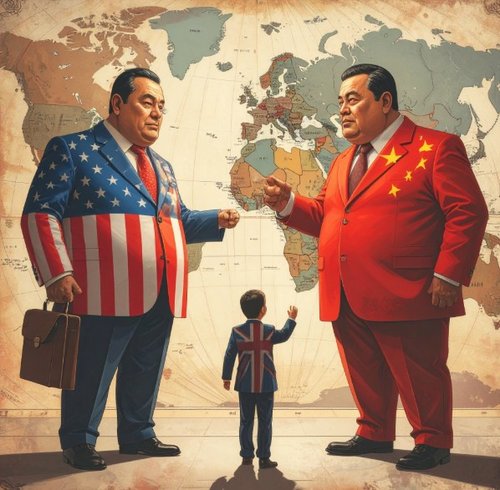
There is much discussion of the role of the UK in the context of the shifting relationships with China and the US in particular, but I would argue that the UK internals are far from secure.
So, the question I want to leave with you is who can and how will we build a consensus moving forward? I wish I had an answer.