Deception Of The Ledger
Saturday, 04 July 2026By Christopher Gleadle

In our corporate boardrooms, we have developed a language designed to comfort us while the ground shifts beneath our feet. For a generation, the financial community has treated the underwriting of long-term assets as an isolated exercise in managing spreadsheets and micro-unit costs. We convinced ourselves that critical inputs like energy, water, and infrastructure were merely passive, fixed overhead to be outsourced to whichever territory offered the cheapest ledger entry.
In 2026, that language has lost its meaning. Geopolitical fragmentation, regional resource wars, and severe supply shocks have exposed the fragile illusion of traditional globalised supply chains and siloed financial markets.
As observed in the seminal text Architecting Autonomous Resilience (Gleadle, C. 2026) true capital performance can no longer be secured by minor adjustments to a broken model. We must look past the tactical obsession with incremental efficiency and look directly at systemic effectiveness. Institutions and nations that survive this era will not be those that execute the old playbook better, but those that rebuild their foundations for genuine autonomy, security, and fairness.
How Inequality Destroys Real Value
Financial markets prefer to operate within neat, artificial boundaries that separate asset classes from the messy realities of human society. This fragmentation does not protect capital; it distorts pricing, obscures true risk and creates profound operational inefficiencies. Extreme macroeconomic inequality is not a temporary glitch in the system; it is a structural feature of an asymmetrical economic architecture.
When the financial architecture swings violently between artificial robustness and structural fragility, the resulting crises do not fall equally. They crush the most vulnerable sections of society, which in turn fractures the civic infrastructure that capital ultimately relies upon.
Consider a public infrastructure asset like healthcare. When systemic poverty drives worsening health outcomes, the institution ceases to be a proactive foundation for societal wellness and transforms into a reactive, overburdened sickness service.1
For the investor, this societal decay is an unpriced liability that manifests in three undeniable ways:
- Volatile Labour Pools: Driven by regional demographic contractions and the flight of top-tier technical talent to foreign capital centres.
- Unstable Public Markets: Plagued by short-term activist pressures and administrative regulatory inflation.
- Degraded Asset Performance: Caused by the quiet, unmapped erosion of the socio-economic foundation beneath the asset.
When inequality compromises the foundation of a society, every financial asset class built upon it will eventually slide into the same trench.
The Illusion of Incrementalism
When a system begins to fail, the immediate institutional response is to demand that everyone run faster in the wrong direction. We call this efficiency. It is a tactical illusion.
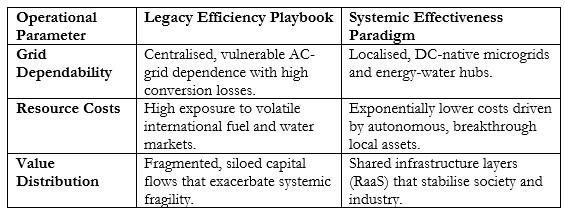
Between 2016 and 2026, modern electricity grids achieved an operational efficiency gain of 20% to 45%. Yet, over that exact ten-year period, cumulative compounded inflation in countries like the UK reached roughly 31.8%. The macro-inflationary wave completely swallowed the micro-efficiency gain, leaving the end consumer exposed and empty-handed.
Incremental compliance and marginal cost reduction amount to nothing more than polishing a vulnerability. When an industrial asset consumes more energy and water than its physical reality demands, it remains a hostage to global market shocks and outside political agendas.
True strategy demands effectiveness. Capital must stop trying to fix the conversion losses of a decaying, centralised AC infrastructure and instead scale breakthrough, native DC microgrids and localised industrial clusters from the ground up.
Fairness And Super-Competitiveness
The only permanent counter-measure to value-destroying inequality is to replace fragile dependencies with localised, co-located energy-water hubs. Energy and water form the dual physical platform that underpins every digital asset, industrial plant, and human life. By bypassing legacy grid constraints through advanced desalination, brine-waste to energy, and decentralised networks, we introduce a level of fairness that translates directly into secure financial returns.
When an entire industrial cluster or society is anchored to a cheaper, resilient power-and-water foundation, it unlocks a super-competitiveness dividend across three dimensions:
- Capital: Lowering the baseline cost of primary resource inputs provides an insurable, physical hedge against global inflation and maritime choke-point risks.
- Industry: High-growth, high-density assets such as AI data centres and green hydrogen facilities gain a permanent operational advantage, completely insulated from technical defaults caused by hydrological stress or macro-grid failures.
- Society: Drastically reducing the cost of foundational resources removes the inflationary chokehold on households and businesses, restoring balance and purchasing power to the wider economy.
Underwriting Truth
Sustainable finance is currently crippled by a profound trust deficit. We have buried the sector under an avalanche of manual compliance tracking, retroactive auditing, and easily manipulated Scope 3 emissions spreadsheets. This is administrative paper-shuffling, not sustainability.
The Sphere Economy framework 1 replaces this bureaucratic box-ticking by deploying localised industrial clusters, such as the SV-Electra architecture, that govern the unified physical flows of power, water, feedstocks, and data simultaneously. The infrastructure asset itself absorbs the tracking burden: Resilience-as-a-Service (RaaS).
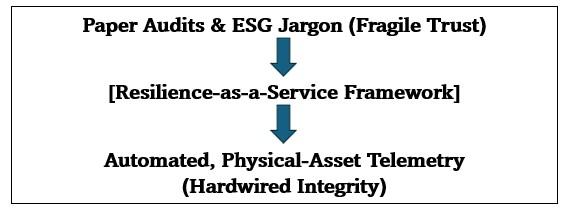
By delivering automated, real-time, blockchain-verifiable data, the RaaS model provides instantaneous, legally defensible proof of resource provenance and carbon footprints. For senior banking executives and fund managers, this eliminates greenwashing risk and strips out the bloated underwriting costs of manual compliance verification. Trust ceases to be an administrative variable; it is structurally hardwired into the physical steel and wire of the asset.
Furthermore, by using the Sphere Economy model to build tenant-shared eco-innovation academies, these clusters anchor specialised systems engineering talent directly to the local geography. This eliminates regional human capital constraints, protects the long-term operational viability of the infrastructure, and transforms a volatile labour risk into a self-sustaining pipeline of local systems mastery.
Secure Returns In An Unpredictable Era
To protect capital from the structural fractures of our time, the banking community must step out of the abstract world of isolated, paper-heavy valuations and begin financing integrated, autonomous ecosystems.
Providing systemic fairness by driving down the baseline costs of power and water is not an act of political charity; it is a clinical, optimised risk-mitigation strategy for capital. It strips out commoditised vulnerabilities, corrects the pricing distortions of siloed markets, and insulates corporate performance from macroeconomic shocks.
By taking absolute control of foundational operational flows through the principles of autonomous resilience, boardroom leaders and sustainable financiers do more than survive immediate crises, they construct a fairer, highly competitive, and fundamentally bankable future.
Christopher Gleadle, Co-Founder and CEO SV-Electra www.sv-electra.com
1 The Sphere Economy, Gleadle, C. 2026, Chapter 7 in Taylor, A. (ed), 2026. The Edge of Chaos. London: Legend Press.