Does The Rise Of AI Mean The End Of The IT Era?
Friday, 14 August 2026By Chris Yapp
Amid the incessant announcements of new AI products and capabilities, it is valuable to listen to some of the contrarian voices about both direction and timescales. AI, as a concept is over 70 years old after all. Two such voices are Arvind Narayan and Sayash Kapoor. They argue , in my view correctly, that AI should be seen as a normal technology.

Back in the 1990s, at a Conference where I was speaking, in a panel session we were asked what the internet/WWW would be once it was universal and no longer seen as a new technology. I described it as a knowledge utility and that it would be understood in the same way as the electricity grid. I see developments in AI as the final stage, not a new wave in the development of a knowledge utility, an infrastructure for the next era. I believe that what we are seeing is the commodification of IT and the economics increasingly resembles energy, water roads and rail - that is to say high capital costs. The days of the extraordinary gross margins for software as a service (SaaS) companies are fading into the past.
We can find evidence of early computing going back 2000 years (theAntikythera mechanism), though most people credit 19th century pioneers Babbage and Lovelace with the creation of a programmable computer. However, the economic impact of computing really became serious in the 1960s with the rise of the mighty mainframes, showcased by snow white (IBM) and the seven dwarves (the Burroughs Corporation, UNIVAC, NCR, CDC, Honeywell, General Electric and RCA) who heavily invested in mainstream commercial computing and timesharing during the 1960s before exiting the market in the early 1970s.

Minicomputer & Scientific Pioneers . Looking at previous technology waves, 60 years is a realistic timescale from initial impact to absorbtion into societal and economic infrastructure. The Internet Protocol, email and even early online communities date to the 70s. The first PCs were mid-1970s. Mobile devices come from the 80s and the WWW is over 35 years old. The iPhone was 2007. I first saw a prototype smart watch on a US visit in the late 1990s, and I would argue that while there have been significant upgrades to capabilities in technology, progress has become incremental rather than radical.
The “excitement” around AI should not ignore that it’s taken a long time to arrive. Much of that is due to the need to reduce the costs of computation and storage in order to deliver on the long promised development of AI.
Rather than look for the next IT inovation with the impact of the iPhone, I think that the real action now is not within IT itself but in a higher level layer - the physical infrastructure that creates and supports networks. For me that is where the real excitement and innovation is now happening.
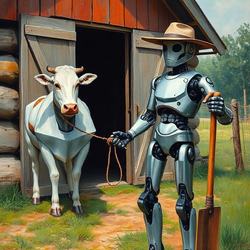
Imagine a conversation with an ambitious and capable teenager about what to study and work towards. To have a fulfilling life and career. I think that areas such as precision agriculture, health and medicine, green technologies are where the smart money is heading. There is an episode of Clarkson’s farm that explores smart technologies in agriculture. It has the same sense of awe that my generation found within computing itself. Drones, robots and autonomous vehicles are highly developed and progress is accelerating.
I am not arguing that there will be no step changes in IT, far from it. We continue to see major innovations within energy systems for instance. However, the need to integrate with the legacy infrastructures can be a barrier to uptake. For instance, imagine if you came up with something that could make the 3 pin plug redundant, the investment required to deploy it would be crippling. At this stage of development, standards can often long outlive the need that created them. Probably the most well -known example is the QWERTY keyboard.
Douglas Adams observation that “Technology, by definition, is anything that doesn’t yet work” is a good way to see the world. Books are the most long lasting Information technology, so far. Computers in the 80s often broke down and were a nuisance, but we could switch to paper based back up systems. Today when the internet goes down we feel as helpless as when power fails, we are paralysed.
Increasing the reliability and resilience of the electricity grids in the face of climate change is a key societal and economic challenge for our age. Engineering the Knowledge Utility for resilience and reliability is the next layer.
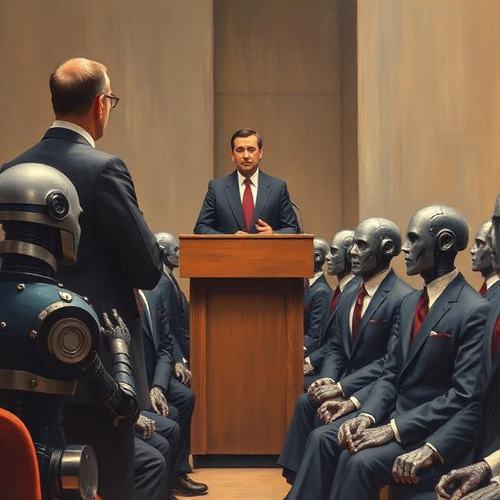
So, my challenge is this. When a Company or a Government states that it wants to be a leader in AI do we really know what that means?
Over the last few months there has been much discussion of the “vision” thing in politics. I’ve been looking to see the vision for AI within the corporate sector, especially services. It seems to still be dominated by replacing junior staff by AI and lowering costs. I’m still struggling to see the truth around claims around better and innovative services for clients.
This having been said, there are some highly interesting ideas in both agriculture and also in drug discovery where real progress is evident.
What are the visions for accountancy, legal services, consultancy and others that will motivate clients to buy? Replacing junior staff by AI agents? If that is the limit of ambition and AI agents were able to replace junior jobs then many corporations would find it easier to bring back many professional services in house. Similarly, if young ambitious tech savvy individuals find the entry level jobs vanishing, then I suspect some niches of today’s services to be open to new entrants. So, I draw you attention to an important quotation: “Where there is no vision, the people perish” Proverbs 29:18
What comes next? The metaphor for our age has been the development of machines. I suspect that what comes next is an age of biological systems thinking, a sustainable circular economy. Opportunities abound.