Is Brexit Breaking Britain?
Friday, 05 June 2026By Graham Bishop

Last year UK In A Changing Europe published a paper predicting "a radical decline in immigration to 175,000 or less". Earlier this year the ONS Population Projection to 2034 found that “Net migration remains the only source of expected population growth, though at a lower level than in our previous projections…. NPPs long-term average annual net international migration assumption is 230,000….”
Total fertility has declined further, from 2026 onwards, deaths are expected to exceed births. At 171,000, long-term international net migration for year ending (YE) December 2025 has nearly halved from YE December 2024 – so it has happened a year early! This level is well below the ONS assumption for its population projections.
The recent internal political challenge to Prime Minister Starmer, prompted by disasterous local election results, has unexpectedly lifted the lid on the long-suppressed Brexit debate. But the political class (except for the Liberal Democrats) immediately responded by trying to nail the lid down again rather than confronting reality.
The latest research shows that the UK has already lost about £400 billion of tax revenue since 2016 (a gap now growing at about £100 billion annually). This is why voters feel Britain is broken and the recent election underlined their demand for “change”. But the political class must level with electors and explain that the root cause is a self-inflicted wound - Brexit.
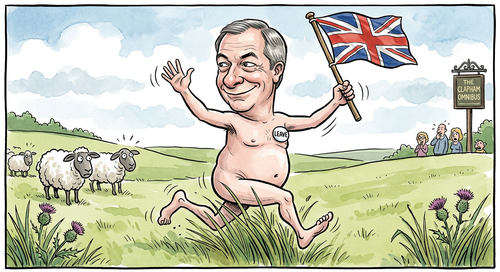
”Emperor” Farage has never had any economic clothes. Without Brexit and at current tax rates, the government would soon have no need to borrow any money at all! Dramatic change could have been financed.
Britain has obvious problems – is there a `quick fix’? Or have they been brewing for decades? Take a long run view over the 40 years from 1985 – half an expected lifetime! That 40-year span included 1987’s Black Monday on Wall Street. A few years later the UK’s first “unset” from Europe arrived: Black Wednesday in 1992 when the “market vigilantes” threw the UK out of the ERM. This was the foreign exchange branch of the market vigilantes but the “bond market vigilantes” showed their irresistible strength during the euro crisis of 2012.
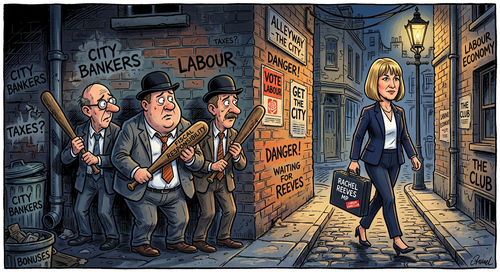
So who are the Bond Market Vigilantes? Well, if a state needs to borrow money from the market, then in an open, international system, the market participants will decide if they wish to lend at the terms offered – or lend at all if they believe the risk of default is too great. Many of these vigilantes are pension funds, and as such, they are only seeking to ensure they can meet their own obligations to the ultimate beneficiaries – citizens/nations saving for their income in retirement. However, their wrath can shape political fortunes.
UK Prime Minister Truss had an unpleasant brush with them in 2022. Even President Trump seems afraid of them, and Chancellor Reeves certainly is, so placating them seems to be a key driver of UK economic policy.
Brexit has steadily pushed the vigilantes into that position of power by:
- Raising our vulnerability to an aging, and increasingly disabled, society where the non-immigrant labour force has scarcely risen in 40 years
- Curtailing economic growth due to reduced immigration
- Stalling business investment due to Brexit uncertainty - and thus productivity growth
- Inducing a cumulative shortfall of tax revenue that is nearly £400 billion since 2016 – and may double by 2030. That shortfall will require a further rise in the tax ratio – to levels last seen in 1944;
- Creating a squeeze on public spending that is not only reducing productivity but is rending the fabric of British society – spending on the non-priority areas has fallen from 16% of GDP in 1985 to 10% today – further fuelling the deep concerns of the holders of Britain’s government debt.
- Creating political instability due to the manifest contradiction between large majorities who think Brexit was a mistake and the opinion polls showing that Reform will be the largest party after the 2029 General Election.
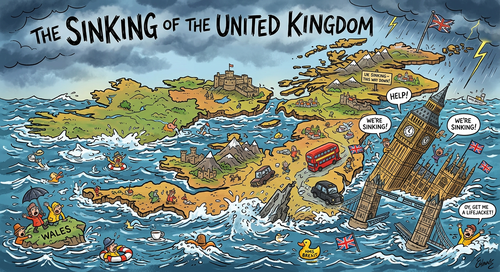
This lengthening list of the consequences of Brexit has created a serious and growing risk of a debt crisis. Extraordinarily - and unaware of the inexorable logic of this chain of events – electors presently seem likely to elevate one of the original (and leading) architects of this disaster to be Prime Minister, despite their historic repudiation at the last General Election of the political party that actually “Got Brexit done”.
Would re-joining the EU and joining the euro be an answer to our economic problems? The biggest political problem may be to convince the EU that we are serious about re-joining as they can read the opinion polls. What are the chances of Prime Minister Farage willingly leading the charge to re-join the EU and then join the euro??? Will the foreign bond market vigilantes leave him no option but to take the “road to Damascus” on this matter?
This piece is a summary of a much longer paper you can find here: https://fedtrust.co.uk/is-brexit-breaking-britain/
Graham Bishop, June 2026
The cartoons in this piece were generated using AI @ Adobe Firefly