My Hovercraft Is Full Of Eels – AI And The Preservation Of Minority Languages
Friday, 25 September 2026By Aleksandra Paravina
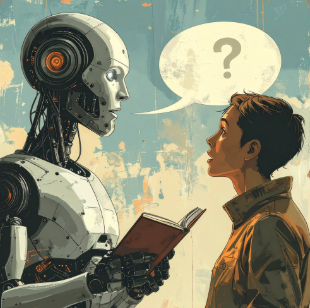
Language is an important aspect of being human and is the bedrock of shared culture in different ethnicities, nations and communities. However, non-native language speaking minority groups are often framed as threats to “societal cohesion” and national identity, and these groups can face intense pressure to “integrate”, frequently at the expense of their languages, which has implications for the preservation of their culture.
History is littered with examples of this - Welsh and Irish were banned in schools in the nineteenth century, and the languages almost went extinct, before undergoing a revival in the late twentieth century. The Ter Sámi language in the Kola Peninsula in north-western Russia, was banned by Stalin in schools in the 1930s and has very few speakers left, and the Catalan language was banned in Spain during the Civil War in the 1939, but was later revived and became an official language in the 1980s.
Increasingly, language has become a touchstone for policy makers tackling concepts of societal integration. The idea is that by assimilating or learning the language of the titular nation, minorities will be able to access better jobs, social mobility, tertiary education, and other opportunities. Ostler argues that minority languages were perceived as a zero-sum game in empires, which promoted the idea that minority speakers had to lose their language in order to gain other things.

However, minorities rarely see the benefit as there are other ways to discriminate against them - being the “wrong” colour, having the “wrong” surname, the “wrong” accent or living in the “wrong” part of town.
We still see numerous examples of resistance to principles of diversity, equity, and inclusion (DEI) in the USA and positive discrimination (affirmative action) in Europe, even though there are numerous EU policies in place which guarantee diversity and equality (Lyons, Mkwesha, and Zacheus 2026).
For once, however, AI has been a remarkable equaliser as AI powered translation systems can help speakers communicate with larger audiences, allow researchers to identify patterns and structures in languages, and support the documentation and preservation of lexicons, and this has been driven partly by companies’ investment in transcription quality.
For minority and endangered languages, this has been a significant change and has also contributed to the dismantling hierarchical power structures in academia, as community members can participate more directly in creation of knowledge and under-resourced researchers are able to transcribe raw data more quickly.
Whilst I was attending a conference in Croatia on Language and Language Data, a linguist I spoke to remarked that we should not emphasise the differences between ex-Yugoslav languages, since they will be replaced by English-centric large language models (LLMs).
I fundamentally disagreed with this idea, as my PhD project focuses on boundary-work—a sociological concept examining how the objective social reality of legally encoded protections for linguistic, educational, and cultural minority rights diverges from the individual and subjective reality of minority members on the ground.
Even in the English language, there are differences between American and British standards, which need to be adhered to in professional publishing. In fact, the nature of language is that it moves fast.
As developments accelerate by Al's growing ability to build the next generation of Al, the question is whether AI will help with preservation of minority languages or cause their marginalisation.
Studies have shown that GenAI can certainly improve the preservation of languages; however, this must involve “community-centric data stewardship,” alongside a structured approach to evaluating potential risks (see Vincent Koc’s work). This approach can be summarised as follows:
- it needs to align with the goals of preserving or revitalising the language;
- communities must maintain their involvement in, and the ownership of, their data (corpora, lexical resources, and other audio-visual materials);
- potential ethical risks, such as bias and cultural misrepresentation, must be assessed, and;
- adequate technical infrastructure and investments are required for successful deployment.
These findings also align with Michael Mainelli’s emphasis on an “intelligent design” approach to language AI, which would accommodate linguistic diversity more deliberately, rather than leaving it to emerge from whatever data happens to be in “primordial ooze.”
Further Reading
Amodei, Dario. 2026. "We Must Pace the Frontier." [Essay/Blog post]. darioamodei.com. Accessed 17 September 2026. https://darioamodei.com/post/we-must-pace-the-frontier.
Bailyn, John Frederick. 2010. "To What Degree Are Croatian and Serbian the Same Language?: Evidence from a Translation Study." Journal of Slavic Linguistics 18 (2): 181–219. https://doi.org/10.1353/jsl.2010.0000.
Buzan, Barry, Ole Wæver, and Jaap de Wilde. 1998. Security: A New Framework for Analysis. Boulder: Lynne Rienner Publishers
Connell, Tim. 2011. "An Introduction to Rare and Endangered Languages." [Video]. Gresham College Lecture Series. Gresham College. Last Modified 16 June 2011. Accessed 18 September 2026. https://www.gresham.ac.uk/watch-now/introduction-rare-and-endangered-languages.
De Paoli, Stefano. 2026. "Why We Should Reject to Reject the Use of Generative Artificial Intelligence in Qualitative Analysis: A Response to Jowsey, Braun, Clarke, Lupton, and Fine (2025)." Qualitative Inquiry 0 (0): 10778004261425137. https://doi.org/10.1177/10778004261425137.
Koc, Vincent. 2025. "Generative AI and Large Language Models in Language Preservation: Opportunities and Challenges." [Preprint]. Accessed 18 September 2026. https://arxiv.org/abs/2501.11496.
Lyons, Minna, Faith Mkwesha, and Tuomas Zacheus. 2026. "“You’re Supposed to Feel Safe, You’re Supposed to Feel Respected, You’re Supposed to Feel Heard”: Lived Experiences of Racism in the Finnish Education System." Journal of Interpersonal Violence 0 (0): 08862605261480161. https://doi.org/10.1177/08862605261480161.
Mainelli, Michael. 2026. "Beyond LLMs - The Primordial Ooze Versus Intelligent Design Of AI." The Pamphleteers Blog, Long Finance. Last Modified 5 February 2026. Accessed 18 September 2026. https://www.longfinance.net/news/pamphleteers/beyond-llms-the-primordial-ooze-versus-intelligent-design-of-ai/.
Miletić, Aleksandra, and Filip Miletić. 2024. "A Gold Standard with Silver Linings: Scaling Up Annotation for Distinguishing Bosnian, Croatian, Montenegrin, and Serbian." In Proceedings of the Fourth Workshop on Human Evaluation of NLP Systems (HumEval), LREC-COLING 2024, edited by Simone Balloccu, Anya Belz, Rudali Huidrom, Ehud Reiter, Joao Sedoc and Craig Thomson, 36–46. Turin, Italy: ELRA and ICCL. https://aclanthology.org/2024.humeval-1.4/.
Ostler, Nicholas. 2011. "Rare and Endangered Languages - 'Why should we protect endangered languages?'." [Video]. Gresham College Lecture Series. Gresham College. Last Modified 16 June 2011. Accessed 18 September 2026. https://www.gresham.ac.uk/watch-now/rare-and-endangered-languages-why-should-we-protect.
Paravina, Aleksandra. forthcoming 2026. "Boundary-work in the Cultural, Linguistic, and Educational Rights of the Croatian Serb and Estonian Russian Minorities " PhD dissertation, University of Helsinki.
Savage, Michael. 2021. The Return of Inequality: Social Change and the Weight of the Past. Cambridge, MA: Harvard University Press.
Teubner, Gunther. 2026. "Emergence and Personification: How the Law Makes Non-Human Entities Speak." In Research Handbook on Law and Systems Theory, edited by Ralf Rogowski, 31–47. Cheltenham: Edward Elgar.