The Property Trap: A Case For Two Government Interventions
Saturday, 29 August 2026By Rob Julian
I want to argue for two types of bold government intervention in the UK's property market. The second kind of intervention I am arguing for is a property tax, of which the arguments are old and well covered, and the likelihood of such a tax is growing to the point of being inevitable in some form I think. The first type of government intervention I am arguing for, however, is not well covered and has little present support or interest. I think the circumstances of the house-building market are such that it will be necessary and justified for government to give subsidies or tax breaks to house builders in some situations. Also, the existence of a future property tax would be expected to lower or hold down market prices, making subsidies to house builders even more necessary. To many of you who appreciate the wisdom of markets and Adam Smith, the suggestion that the same market should be both taxed and subsidized might seem to be inefficient and confused. But I aim to argue that housing is a sector with specific factors and qualities which make this apparent contradiction a good idea.
Due to the nature of the processes involved, house building has seen slower productivity improvements than the rest of the economy, adding to the recent rise in material costs.
As economies grow and the populations within them get richer, the costs of goods and services in different sectors of the economy change in relation to each other. Sectors which can benefit from mechanization and economies of scale, or from trade with low-wage countries, produce cheaper goods and services which improve the population's purchasing power dramatically. But sectors which rely on skilled domestic labour become relatively more expensive. In a successful economy, incomes should usually grow faster than GDP, so over time this changes the dynamic between which sectors absorb the economy's purchasing power / GDP.

Building houses consists of many tasks and professions which have not experienced much productivity gains, can achieve limited economies of scale, and cannot benefit much from imports from low-wage countries. The recent surge in the price of materials also adds to this. Building houses still means digger drivers, cement mixers, brickies, carpenters, roofers, plumbers, electricians, plasterers and painters, all turning up and putting the hours in, and earning a decent rich-country wage.
To say the sector has not experienced productivity gains is not meant as a criticism of those professions, but is just an arbitrary fact dictated by the nature of the tasks involved. Like every other non-government sector in the economy, the magic pressures of capitalism combined with human ingenuity can be trusted to search out productivity gains and innovations. But it must be accepted that with many of these physical tasks there are few gains to be had. For example, there are many robots in modern factories and some warehouses, but none yet on the average building site. There is a chance that the house building ecosystem has gotten used to easy profits and high wages, and could manage on slightly lower house prices if forced to over time, but I am not sure about this. With some competition, the companies and tradesmen involved would usually be expected to take up profitable opportunities.
If the costs of average new-build houses are rising above affordability for the average middle-class buyer, then we need to subsidize the costs if we want more houses.
If a sector like house building cannot make productivity gains through mechanization, economies of scale, or trade, its relative costs will go up faster than average prices across the whole economy. We might be able to get cheap clothes, food and tech, and even cheap cars relatively speaking. But housing will claim the spending power released by the savings made in these other sectors, as the cost of skilled and semi-skilled labour turning up to do stuff to property in a high-wage economy bucks the productivity trend. It has been easy in the UK (including myself) to characterize high house prices as a bubble caused by easy credit and a shortage of supply. But when there is evidence that house builders are now holding back from building due to margins being too tight, then we need to think again. As mentioned in this article, in nominal terms, over the last four years, the costs for house builders have gone up by 17.5 percent, while house prices have only gone up 4.5 percent. Savills UK | Completion Forecasts - June 2026 If interest rates remain at a more historically normal level, and mortgage lenders continue sensibly to be more cautious in their lending, there is nothing stopping a situation where, for the first time in history, eventually the average middle-class professional family cannot afford the building costs of the average new-build house. As a country, we must have these purchases happening at a growing rate, and not tailing off.
The sharpest amongst you may have noticed a slight circularity in my argument? If house prices are going up faster than GDP partly due to rising incomes of the tradesmen involved, surely these rising incomes will help mortgage affordability? This is a good point, but when a growing economy usually means prices of goods and services getting cheaper compared to incomes due to mechanization, economies of scale and trade, the pattern of a sector like house building seeing higher costs due to a high exposure to rising domestic incomes, I would argue, translates into a deteriorating relationship. The best explanation for this is the extra factor of all the taxes, necessary profit margins, and tertiary costs which are added along the supply chains and processes to the rising incomes, multiplying the impact in terms of total cost rises for this sector.
Before we subsidize house builders, we could start by taking away some of their peripheral obligations and costs.
The price of newly built houses obviously will reflect all the costs involved. As well as the rising labour and material costs mentioned above, new house prices also reflect the price of the planning process, both for that property and absorb the costs of those planning applications which were not successful. With the UK planning system being so long-winded and open to local challenge and appeal, this creates an extra cost for all new-builds. There are also obligations on house builders to provide funds for planning obligations, like improvements to local roads and including some affordable housing in their development at cost price or less. Also, there might be obligations to improve or redress 'biodiversity net gain' in the area. When the margins produced easy profits, it was easy to load property developers and house builders with many conditions and planning demands, but if an era comes where projects struggle to reach affordable end prices, maybe some of these extra demands need to be stripped away? After all, we don't force car manufacturers to produce one cheap car at a loss for every eight high-spec ones they produce? Just like the buyers of new cars sell their old cars to the less well off, so those who buy new houses usually have moved out of another less expensive house, and therefore have increased market supply for those less well off.
A property tax and subsidy combination is desirable for this special kind of market.
Part of the solution to the UK's property issues must be that we choose to even things up by taxing the owners of property more. Unlike a wealth tax, property taxes are more black and white to administer, and houses cannot hide from the HMRC in tax havens, shell companies or trust funds. A property tax replacing stamp duty and council tax would also encourage empty properties to be sold and some people to downsize. A 'Land Tax' approach goes further in recognizing the community nature of location values, and encourages land in desirable locations to be used more efficiently. Michael Mainelli: As I See It - The Windfall We Keep Giving Away - Who Profits When London Improves?

A property tax, if it is substantial, will inherently pull or keep prices down, as for any asset, if it is worth less to own it, its price will go down. A property tax could proactively target house prices: e.g. by raising property taxes until the average house value roughly freezes nominally, until slowly over time in real terms it reaches, say, six times the average income? This would be higher than previous ratios, but lower than they presently are, so a happier medium between real costs and affordability. But then falling (or nominally static as in recent years) house prices would make even worse the present reluctance of house builders to build. So I believe a property tax would have to be twinned with tax breaks aimed at supporting house building, at least in the areas which do not command high prices due to desirable location. These tax breaks might relate to location and property type.
From an economist's point of view, all policies which distort the prices faced by those acting within markets should be approached with caution, due to unexpected consequences and distorting side effects. But I would support bold interventions here, as I think the costs of leaving things to market forces would be much worse. And even the conceptual ideal of leaving things to market forces is not really an accurate or achievable option, due to the reality of the government paying the rent of so many households, and therefore artificially boosting demand in the market. We are already knee-deep in government interventions and nowhere near a 'free' housing market!
This combination of a property tax and tax breaks or subsidies for house builders where necessary would address the issue of property being both such a uniquely long-lasting asset, which is a massive unearned windfall to some, and also something which is getting such an expensive and restricting issue for others. While an old car becomes more unreliable and less desirable compared to a new one, a 200-year-old house is still just as valuable as a new-build. Even investing in long-term assets for business rarely achieves the durability of value that a house can achieve, as business technologies and consumer habits change. Houses really are a special type of asset that warrant special treatment. As property is becoming a bigger deal in people's economic lives, the difference between those who bought property decades ago, or who have or will inherit property wealth, becomes ever more stark, unfair and bad for society. As Thomas Piketty colourfully describes, a society with high inequality, like Britain and France in Victorian times, meant that what one inherited, possibly making one a 'rentier' earning money in your sleep, mattered more than what one earned through work, and few people think that is desirable or sustainable.
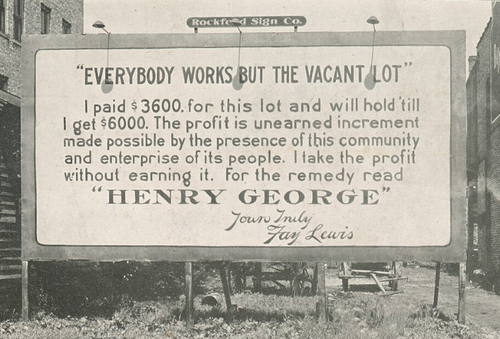
The argument of very popular 19th century American economist Henry George in his best-seller 'Progress and Poverty', was that much of the value represented by property and rent prices was reliant on their location within towns and cities, and the value of a location in a town or city was something created by the 'commonwealth' of government infrastructure and the ecosystem or positive externalities of other housing and businesses nearby. So following from this assertion, if the government and the local community were contributing to the profits and price rises of property owners and landlords, then the government was justified in reclaiming some of this value back in a land tax (something very much advocated by the excellent Fairer Share organisation - Council tax is broken. Help us fix it.)
“The tax upon land values is, therefore, the most just and equal of all taxes. It falls only upon those who receive from society a peculiar and valuable benefit … It is the taking by the community, for the use of the community, of that value which is the creation of the community.”
The controversial present-day Marxist economist Michael Hudson takes George's arguments further, claiming that much of economic history can be seen as a struggle against the dangers of oligarchic wealthy families growing their wealth through the advantages of landlordship, cornering markets and gaining political influence. His favourite example is of the Near-East Bronze-Age kings, who tried to limit the takeover of their economies and the inequality it produced, by forgiving debts in debt jubilees, and having property taxes which claimed the natural rise in asset values for the country, rather than the private owner. Below are quotations from Michael Hudson's book: 'The Destiny of Civilization.'