What Happens When A Financial Centre Runs On Money Its Own Central Bank Cannot Make?
Friday, 07 August 2026By Yuan Gao
Bagehot’s Unstated Principle

Walter Bagehot’s prescription for a panic is the most quoted sentence in central banking: "lend freely, at a high rate, against good collateral". A century and a half of argument has gone into every word of it — how freely, how high, how good. Yet the word carrying the most weight is one Bagehot never wrote down, because in 1873 he did not have to. “Money will not manage itself,” he warned, “and Lombard Street has a great deal of money to manage.” It went without saying that the money in question was sterling, and that the Bank of England could make as much of it as a panic might demand.
Stand on Lombard Street today — it is still there, a few minutes’ walk from where these pages are edited — and the unstated premise wobbles. The City is the world’s largest centre for foreign exchange and for over-the-counter interest-rate derivatives; roughly four-fifths of all cleared euro interest-rate swaps pass through one London clearing house; and it is a principal venue for offshore dollar funding, for metals, energy and gold, and for the insurance of the world’s shipping. The money Lombard Street now manages is mostly other people’s. In a genuine panic, the money the City would be short of is, in large part, money the Bank of England cannot print.
What About Everyone Without the Privilege?
A companion pamphlet in these pages argued that the safety of a sovereign bond market is a property of the network around the asset, not only of the issuer. Twice in recent years a central bank has had to buy its own safe asset to keep it safe — the Federal Reserve in March 2020, the Bank of England in October 2022. What protects the United States is not that its market is sturdier, but that in a dollar crisis the Federal Reserve can create the very thing the crisis demands. Economists call this the exorbitant privilege. The obvious next question is what happens to everyone who does not have it.
A Panic, Measured In Pence
Every financial panic runs on the same engine. Someone is forced to sell; the sale moves the price; the move forces the next sale. The question that decides everything is a homely one: does each round of forced selling cause more selling than the last, or less? If less, the spiral burns out on its own. If more, it feeds itself until someone outside the loop absorbs it. My work measures, from public data on who holds what and who must sell when prices fall, where a market sits on that scale — expressed as the new forced selling that one pound of forced selling produces in the next round. Ninety pence, and a panic fades. A pound or more, and it feeds itself. That yardstick is all the machinery this essay needs; the charts call it the amplification factor, and the pound-for-pound line the runaway threshold. The maps, assumptions and stress-tests behind each number are in the full report, for readers who want them.
Where Does the Backstop Run Out?
Measured this way, the sobering finding is not any one number. It is that London, the euro area and the United States all now sit close to the levels seen on the eves of their own past crises — so the interesting comparison is not “which centre is most fragile?” but “when the spiral comes, who can catch it, and where does each catcher’s reach run out?” Every backstop has a boundary, and it can be drawn along three concrete lines. Currency: can the central bank print what the panic will be short of? Counterparty: do its facilities reach the pension funds, hedge funds and clearing members that now carry the risk, or only the banks? Condition: is support unconditional, or hedged with terms that may fail exactly when they are needed? Where a market’s load-bearing pieces fall outside that boundary, the centre has a gap: a place it can break that no existing facility directly covers. Put shortly: a lender of last resort is only as good as its reach. And it is the shape of the gap, not its depth, that decides how each centre would break.
Liquidity In Somebody Else’s Currency
Map the whole City this way — the gilt market and its hedgers, the clearing houses, offshore dollars, foreign exchange, metals, gold, insurance, the dealer banks — and the measurement comes back at 88 pence on the pound. The City is not on the edge: on today’s wiring, a panic there still fades rather than feeds. Two features of the answer are less comforting. The feedback runs through no single place, but through dozens of interlocking loops with no dominant balance sheet — so there is no single door a rescuer could stand behind; 2008 had that shape, which is why containing it took a wall across the whole system. And what enters mostly stays, circulating from balance sheet to balance sheet rather than draining away. London’s celebrated depth, meanwhile, is produced by the market’s own machinery — netting inside the clearing houses, dollars recycled through repo and foreign exchange — not by any central-bank guarantee. The same wiring that supplies the liquidity in calm markets transmits the squeeze in stressed ones. The City’s liquidity is, in the last resort, nobody’s liability.
One finding corrects a natural intuition. London’s clearing is split across three legally separate central counterparties: rates and foreign exchange; metals; energy. Separation looks like diversification. Under stress it is not. The three share the dealer banks that are members of all of them, and the collateral pool from which every one of them funds its margin. Shock any of the three, and the most stressed point in the system is that shared pool — whichever door the shock came through. The two London clearing emergencies of 2022, nickel in the spring and gilts in the autumn, were not unrelated accidents in different markets. They were the same channel, activated twice.
Separation is not independence: three legally distinct clearing houses, bound by common members and one collateral pool.
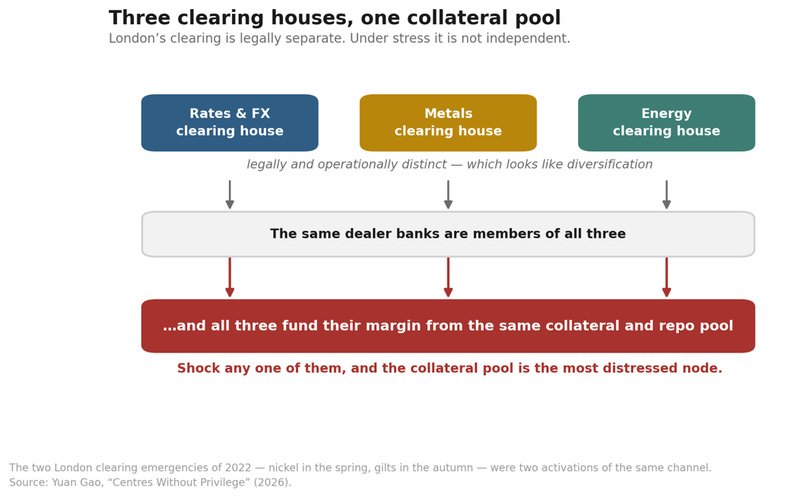
The Spiral That Was Caught — And Mended
“In wild periods of alarm,” Bagehot also wrote, “one failure makes many, and the best way to prevent the derivative failures is to arrest the primary failure which causes them.” Autumn 2022 is the cleanest modern demonstration of his point. The leveraged hedges that British pension funds held against their liabilities formed one dominant loop through one node — the easiest kind of spiral to arrest. The Bank of England announced it stood ready to buy up to £65 billion of gilts and in the event bought £19.3 billion, because the announcement did most of the work. Then came the rare part: the structure that produced the loop was itself reset, with the funds now required to hold liquidity against a rate shock three times the size they had to withstand before. On the eve of the crisis, a pound of forced gilt selling was producing about 91 pence of new forced selling in the next round; on today’s wiring, about 61 pence — the difference between a spiral that must be caught within days and one that fades on its own. Measured, caught, and durably mended: the only case in the record where all three happened, and where the supervisory work came before the next crisis rather than after it.
The exception that proves the method: a fragility measured, caught, and the structure behind it durably reset.
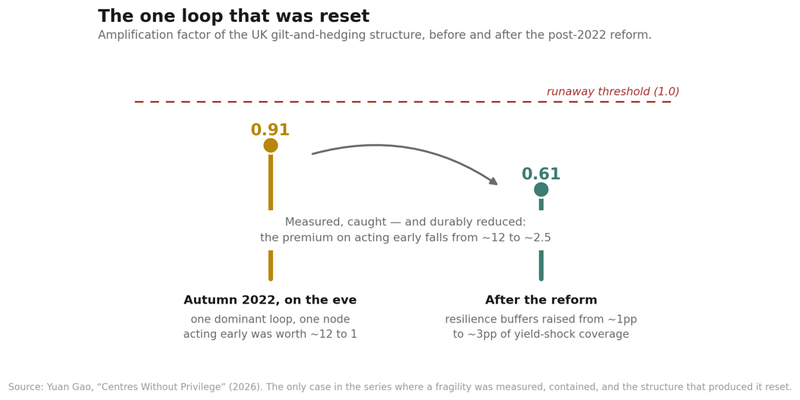
That is also the answer to anyone who assumes political churn must erode a financial centre. Through a decade of it, London remains second in the world, and was one of only two Western European centres whose rating rose in the March 2026 Global Financial Centres Index. Depth of that kind is institutional, not political. None of the load-bearing loops runs through Westminster.
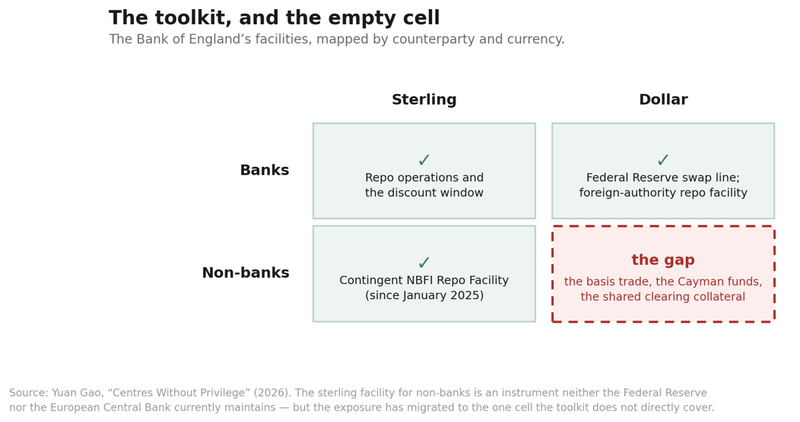
The gap is elsewhere, and it is precise. Set the Bank’s toolkit on a simple grid: banks and non-banks on one axis, sterling and dollars on the other. Sterling to banks — repo operations and the discount window. Dollars to banks — the standing Federal Reserve swap line. Sterling to non-banks — covered since January 2025 by a facility lending against gilts, an instrument neither the Federal Reserve nor the European Central Bank yet maintains. Three cells ticked. The fourth cell, dollars to non-banks, is empty — and it is exactly where the exposure has gone. The dollar-funded Treasury positions of hedge funds, run substantially out of London, have grown to roughly a trillion dollars; borrowing in the gilt repo market stands at its record; and the concentration is striking — seven funds account for nine-tenths of it.
Three cells covered, one empty — and the exposure has migrated to the empty one.
An Unlimited Currency, A Conditional Promise
The euro area is the mirror image, and its gap is routinely misdiagnosed. The European Central Bank can issue euros without limit; on the currency test it is stronger than the Bank of England. What it lacks is not a printing press but a common treasury. A unitary state stands behind its own debt unconditionally. A monetary union without a fiscal union can only promise conditionally — and the conditions are the gap.
Today the euro area’s sovereign-and-bank loop measures 96 pence on the pound: within a whisker of self-feeding, and almost exactly where it stood in the crisis year of 2012 — under today’s quiet prices. And the fragility is moving house. France now carries part of the feedback outside the Italian hub the rescue instruments were designed around, with more than half of its debt in foreign hands. Yet eligibility for the ECB’s bond-buying protection turns on compliance with the EU’s fiscal rules, and France is currently in breach of them. So eligibility rests on precisely the fiscal and political credibility that a crisis would destroy: the tool is least available to the country that has become the centre of the fragility, now it would be most needed. Worse, this close to the line, speed is nearly everything — support deployed at the start of a spiral does many times the work of the same support deployed late — and a conditionality assessment is the one step guaranteed to be slow.
Worse Than the Sum Of Its Parts
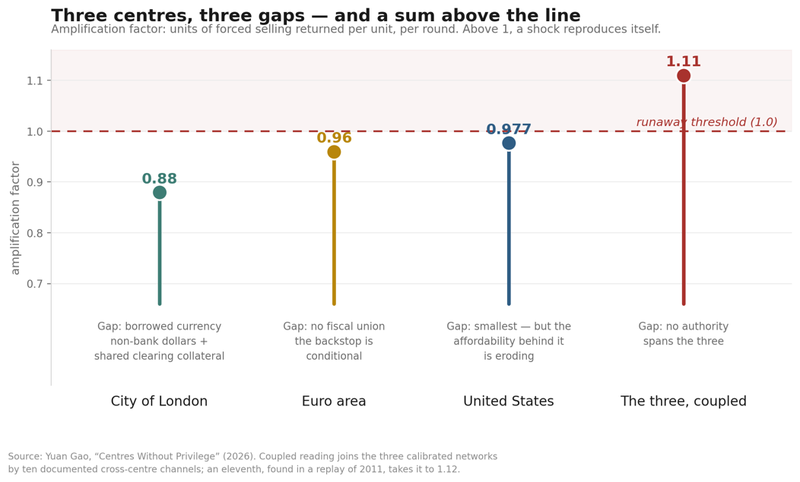
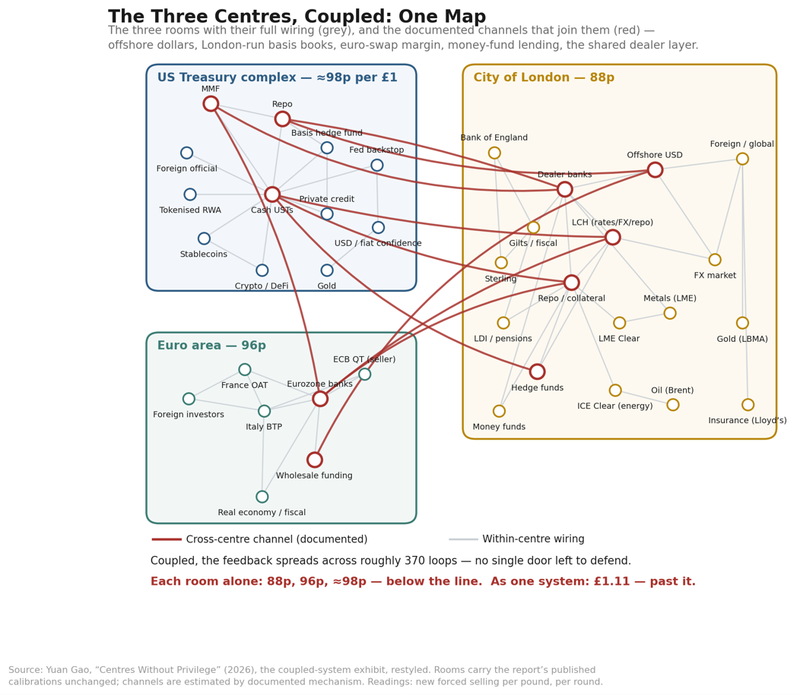
Alone, then, each centre is below the line at which a panic feeds itself: London at 88 pence on the pound, the euro area at 96, the United States at nearly 98. But they are not alone. They are joined by channels that are documented, large and already load-bearing: the offshore dollar funding that flows through London; the basis trades managed from London that hold New York’s Treasuries; the euro swaps cleared in London whose margin calls land on euro-area banks; the American money funds that lend to banks on both sides of the Channel. Join the three maps by those channels and measure the whole as one system, and the answer comes back at one pound eleven — past the line. On the combined wiring, a pound of forced selling anywhere returns more than a pound. And the finding is not delicate: weigh every channel cautiously, or cut any two of them outright, and the reading still crosses the line.
Read that carefully, because it is a statement about the wiring, not about today’s markets — and emphatically not a claim that a spiral has begun; markets are visibly calm. It says something narrower and more useful. Within each centre, a panic still fades. Between the centres, it feeds. What keeps the whole below the line in practice is not the structure but the backstops — and the backstops are national, while the feedback is not.
Three centres, three gaps. Measured alone, each sits below the line at which a panic feeds itself; measured as one system, joined by ten documented channels, the reading crosses it.
Doors Without Doorkeepers
Here is the genuinely surprising part, and the hopeful one. Every pre-crisis market I have mapped has been one room: no internal walls, which is why every successful rescue on record has been a facility bolted on from outside rather than an internal barrier that held. The three-centre system, measured as one, is the first structure in the series with real internal walls. They are the three centres themselves; the ten cross-border channels are the doors between them. The architecture of containment, in other words, already exists. What is missing is not design but custody: the margin rules at the clearing seam and the swap lines at the funding seam sit across jurisdictions, and no single authority holds them.
The full map, restyled from the report: three rooms, thirty-seven balance sheets, and the documented channels between them.
The remedies are correspondingly unheroic — evolution, not revolution, as this house likes to say. Publish the map of reach: for each centre, who can backstop what, in which currency, on what condition, so that the empty cells are visible before they are tested rather than after. Extend the swap-line logic, the one standing cross-border instrument, to the seam that bypasses it: dollars for banks is a solved problem; dollars for the funds and clearing members who now carry the risk is not. And treat the share of euro clearing still done in London as the gauge it is — a published measure of a dependency that a decade of “strategic autonomy” has not moved. None of this needs a treaty. It needs the gap located, which is a measurement problem before it is a political one.
Ninety-five years ago, the panic of 1931 broke London’s specialised acceptance houses while America’s large, diversified banks were barely scratched. The lesson was that organisation decides exposure: what breaks is not the most exposed centre, but the one whose structure routes the shock through a place its own backstop cannot reach. The companion pamphlet argued that the safe asset’s safety should be measured, not assumed. This one adds only that the same goes for the rescuer’s reach. Bagehot’s rule still stands; it simply carries a premise, and the premise has become a question worth asking out loud. Lend freely — in whose money?
Dr Yuan Gao is CEO of Pangura Limited. This pamphlet draws on “Centres Without Privilege”, Part II of The Geometry of Market Fragility, where readers who want the theory, the calibrations and the simulations behind every number here will find them — each one openable and re-runnable.