What You Are Missing About Party Manifestos
Tuesday, 14 April 2026By Chris Carr
Back in the day, when I were a lad, the two main UK political parties had about a million members each. That meant that several million people – their families and close friends – were actively engaged in what parties said and did. When they published a manifesto, whatever their internal processes for creating it, it reflected a broad consensus. From the far left to the centrists later known as Blairites, and from the far right to the ‘one nation’ or ‘compassionate’ conservatives, both parties embraced and compromised across a wide range of views.
Over my lifetime those memberships have declined dramatically (see chart 1). The surge of Corbynism took Labour back to 552,000 in 2017, but it is now under half that – about the same quarter-million as the Greens and Reform. The Tories are languishing behind on half as much again.
Chart 1 Political Party Memebership 1970 -2018
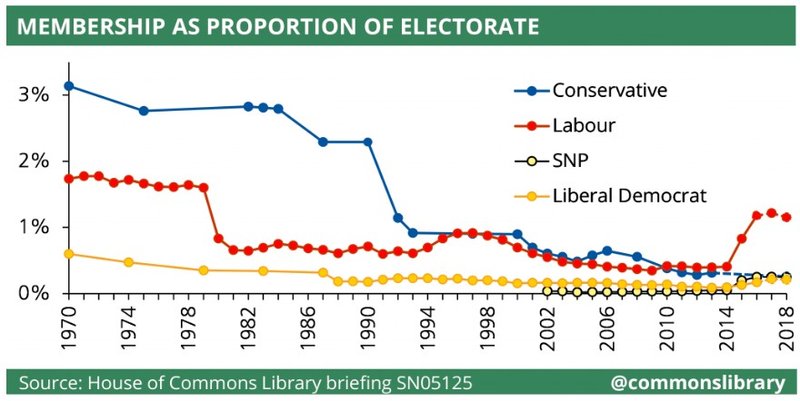
The total number of party members may not be much less than half what it used to be, but nowadays, when a party publishes a manifesto, far fewer people have been involved. To put it unkindly, they’re written by PPE graduates – or AI – and shaped by focus groups. Theresa May’s 2017 manifesto was famously written by two people called Nick and Fiona. This changes what they say and what they’re for.
I’ve recently left the Civil Service after 30 years and eight elections. For the last three, I was in charge of the government’s regulation policy unit. Leaving aside its wider remit of trying to deliver the government’s self-defeating 25% “admin burden reduction target” (which is a topic for another day), the unit has a little-known and very interesting role. Every time there is an election, its analysts go through every major party manifesto and estimate the regulatory burden added or removed by each commitment.
This is necessarily an extremely rough approximation. Even the most widely-used models for regulatory burdens are pitifully inaccurate (which is another topic for another day), and manifestos are intended as public overviews not detailed policy proposals. So a lot of assumptions get made and the final totals are only accurate to within a billion or two – but that’s enough to tell you whether the manifesto is likely to increase or decrease the UK’s net regulatory burden.
You might think, from everything governments of all parties say about “cutting red tape”, that their manifestos are thoughtfully orientated towards doing so. You would be wrong – in fact the opposite is true. You see, governments really only do three things (domestically I mean – so not counting wars and treaties and other international stuff) – they tax, they spend, and they regulate. Those writing the manifesto know that they must avoid spending commitments, lest the newspapers, guided by analysis from the Institute of Fiscal Studies (IFS), start alarming people about possible tax rises to pay for them. So in order to show that they are serious about tackling any given problem without committing to spend money on it, they propose new regulation.

This means that manifestos are bursting at the seams with new regulations – usually in the £5-10 billion range, and frequently higher than that. Across the last three elections only one manifesto promised less than £5bn of new regulation – the 2019 Conservative one – and even that came in at plus £1-2bn net. I am not aware of any manifesto in my adult lifetime containing promises that added up to a net reduction in regulation.
This is quite problematic. Commentators talk about the “regulatory ratchet” effect – that regulation is, for several reasons, much easier for governments to introduce than to remove, meaning that it accumulates over time anyway. This is what makes governments feel that they have to declar war on red tape, march through regulators etc. etc. Yet when they say so, early in their first term, the Civil Service turns around and says words to the effect of “Really? That’s not what your manifesto says”. This contradiction is then loudly ignored until the next election. (This, incidentally, is why the current 25% target is specifically about “admin costs”, because that allows it to ignore much larger “policy costs”, and thus not conflict with the manifesto.)
I have focused on regulatory burdens because that is my experience and area of expertise. But the problem is wider than that – there is no meaningful quality assurance of manifesto commitments at all. Opposition parties are allowed extremely high-level discussions with Permanent Secretaries in the weeks leading up to elections, but they do not assess deliverability in any detail, they are mainly concerned with machinery of government proposals and legislative priorities. Nobody, in the Civil Service or outside, looks critically at the promises and works out what is needed to make them happen, and what could get in the way. Detailed delivery planning is very rare – only Universal Credit springs to mind as an example of a policy fully thought-out in opposition, and it still had massive implementation difficulties. The current government’s manifesto contained proposals for a football regulator, a Regulatory Innovation Office, and something called Making Work Pay. They have all been delivered within two years, which is commendable, but all of them involved messy compromises and suboptimal implementation.
So what can be done? I have two proposals, one micro and one macro.

The micro one is that the scrutiny of manifesto commitments ought to be a more rigorous part of our electoral landscape. As noted above, the IFS does some analysis of spending commitments, and this could be enshrined in a formal process (perhaps run by the Office of Budget Responsibility), alongside analysis of regulatory burdens (by the Regulatory Policy Committee) and deliverability challenges, providing the public with objective and impartial views. There would of course be arguments about the accuracy – these might actually push the parties to provide more details of their proposals, enabling refinements to the figures.
The macro one is that we need much more crowdsourcing of thinking and dialogue before manifestos are written. We need to get back to a place where most of the voting public recognises at least something in a manifesto, feels ownership of it, and a decent chunk of them actually read it. To be fair, some of the parties appear to be thinking along the same lines so it will be interesting to see what happens in the next couple of years. But what would really help all of them, and everyone who cares about whether the country is well run, is a national effort to engage people in thinking about policy choices and design. Only by increasing awareness and literacy of these things can we hold our politicians to account in a way that improves their proposals.